
Protein gets a lot of credit in diet advice. A study of more than 120,000 people suggests that the type of protein food matters more than protein as such. Some protein foods went with less weight gain over the years, some went with more, and several made no difference at all. Here are the five groups that came out on the right side, and what else the study found.
Where the five come from
The study was published in the American Journal of Clinical Nutrition in 2015 by researchers at Tufts University and the Harvard School of Public Health (PubMed 25854882). It used three long-running US cohorts, the Nurses' Health Study, the Nurses' Health Study II and the Health Professionals Follow-Up Study, with 120,784 men and women followed for 16 to 24 years.
The team looked at four-year changes in what people ate and set them against four-year changes in weight. They adjusted for smoking, physical activity, television time, sleep, body mass index and the rest of the diet. This is an observational study. It shows which habits went together, not what caused what.
For each extra daily serving, seven protein foods were linked with relative weight loss of between 0.14kg and 0.71kg over four years. The study summary gives the range for the group, not a separate figure for each food, so the list below is not ranked.
1. Yogurt
Yogurt is on the list. USDA FoodData Central gives plain low-fat yogurt 63 kcal and 5.25g of protein per 100g, so it is a light food by weight. The same study found no link either way for milk, so the result is not simply about dairy.
2. Walnuts, other nuts and peanut butter
Walnuts, other nuts and peanut butter were all linked with relative weight loss. That may surprise anyone who counts calories, because FoodData Central puts walnuts at 654 kcal per 100g and unsalted smooth peanut butter at 598 kcal. Peanuts themselves showed no link in this study, which shows how food-by-food these results are. A spoonful of peanut butter is not a licence to eat the jar.
3. Chicken without the skin
This one comes with a clear contrast. Chicken without skin went with relative weight loss, while chicken with skin went with weight gain. FoodData Central lists roasted chicken breast at 165 kcal and 31.0g of protein per 100g as meat only, and 197 kcal with 29.8g of protein with the skin on. The skin is the only difference between those two entries.
4. Low-fat cheese
Low-fat cheese was linked with relative weight loss, and regular cheese with gain. Cottage cheese is one low-fat example, and FoodData Central lists the low-fat version at 72 kcal and 12.4g of protein per 100g. Cheese also showed the study's most interesting twist, covered further down.
5. Seafood
Seafood rounds out the list. As one example, FoodData Central gives cooked Atlantic cod 105 kcal and 22.8g of protein per 100g. The study grouped seafood together, so it does not single out any one fish.
The protein foods that went the other way
Meats, chicken with skin and regular cheese were linked with weight gain, between 0.13kg and 1.17kg per extra daily serving over four years. Milk, legumes, peanuts and eggs showed no link either way. So "eat more protein" is too broad. In this study the specific food made the difference.
What the protein replaced
The most useful finding may be about swaps. People did not trade one protein food for another, such as chicken for red meat. They traded protein foods against carbohydrate foods. The quality of that carbohydrate mattered too. A rise in glycemic load, a measure the study used for carbohydrate quality, went with 0.42kg more weight gain for every 50-unit increase.
Cheese shows how the two interact. More cheese went with weight gain when glycemic load rose at the same time, with a stable weight when it did not change, and with weight loss when the cheese replaced high-glycemic-load carbohydrate. For cheese at least, what it replaced mattered as much as the cheese itself.
Dates on a plate with these foods
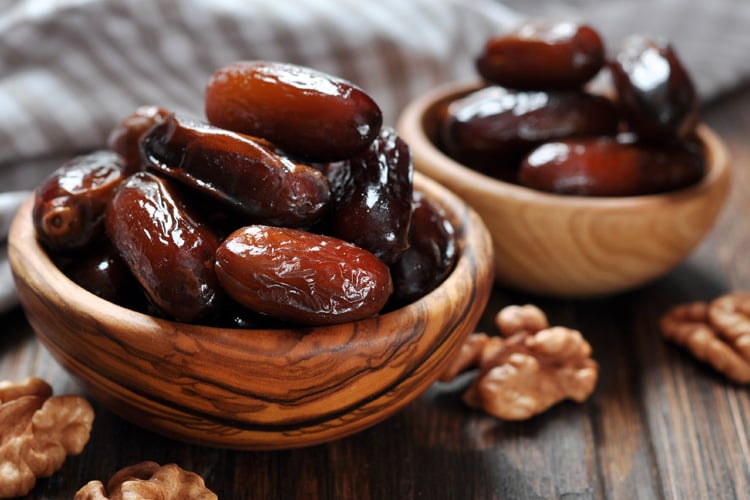
Dates were not part of this study, and they are not a protein food. FoodData Central lists Medjool dates at 277 kcal per 100g, with 75g of carbohydrate and only 1.81g of protein. They sit on the carbohydrate side of the trade-off described above.
The NHS says a 30g portion of dried fruit, such as dates, counts as 1 of your 5 A Day, but should be eaten at mealtimes, not as a snack between meals, to reduce the impact on teeth. If you enjoy dates, keep to a 30g portion and have it with a meal, for example alongside yogurt or nuts. That portion is about 83 kcal of Medjool.
Buying dates from Kurma Nabi
Kurma Nabi supplies dates at retail and wholesale prices and delivers across Malaysia, as its about us page explains. Customer service and price quotes are handled on WhatsApp, through the contact page. More reading is on the Kurma Nabi blog.
An earlier version of this post linked to https://KurmaHarga.com, and that link stays here.
This article is general information, not personal advice. If you plan a big change to the way you eat, speak to your GP or a dietitian first.