
"Raw meals" for skin usually means piles of uncooked vegetables. Olive oil poured over a salad is eaten raw too. A French study of nearly 3,000 adults looked at fats in the diet and the signs of sun-related ageing on the face, and its main result is about olive oil. Below is what that study did, what it can and cannot tell you, and where a few dates fit on the same table. This is general reading, not medical advice.
The SU.VI.MAX skin survey
Latreille and colleagues published the study in PLoS One in 2012 (PMID 22970231). It was a cross-sectional study run inside the French SU.VI.MAX cohort, and it included 1,264 women and 1,655 men aged between 45 and 60. Each person completed at least ten 24-hour diet records during the first two and a half years of follow-up, which let the researchers estimate how much monounsaturated fat each person ate and from which foods.
Trained investigators graded the severity of facial photoaging (skin ageing linked to sun exposure) during a clinical examination, using a six-grade scale illustrated by photographs.
What it found
A lower risk of severe photoaging was associated with higher intakes of monounsaturated fat from olive oil, in both women and men. No association was found for monounsaturated fat from animal sources, whether dairy products, meat or processed meat.
The authors wrote that the findings support a beneficial effect of dietary olive oil, or of the healthy eating habits that go with olive oil use, on the severity of facial photoaging. That second half matters. In a single snapshot like this, people who use more olive oil may also differ in other ways, and the abstract itself leaves that door open.
Two more points belong with the result. The first author's listed affiliation is CERIES, a research centre on human skin founded by CHANEL, and the paper's competing-interest statement says three authors are CERIES employees, with no products to declare. And the outcome was graded from appearance at one examination. Nobody was given olive oil and followed to see whether their skin changed.
Olive oil and dates on paper
USDA FoodData Central (SR Legacy, 2019) shows why olive oil and dates sit in very different places in this story.
| Per 100 g | Olive oil | Deglet Noor dates |
|---|---|---|
| Total fat | 100 g | 0.39 g |
| Monounsaturated fat | 73.0 g | 0.036 g |
| Saturated fat | 13.8 g | 0.032 g |
| Vitamin E (alpha-tocopherol) | 14.4 mg | 0.05 mg |
| Energy | 884 kcal | 282 kcal |
The Medjool record lists 0.15 g of total fat per 100 g and gives no monounsaturated fat figure. So on these records, dates bring almost no fat of any kind, and nothing in the French study is about dates. Olive oil is also energy-dense, at 884 kcal per 100 g.
The NHS page on fats lists olive oil, rapeseed oil and spreads made from these oils, avocados and some nuts among the foods where monounsaturated fats are found. It also says current UK government guidelines advise cutting down on all fats and replacing saturated fat with some unsaturated fat.
Where dates fit
Dates count as fruit, not as a fat source. The NHS 5 A Day page says a 30g portion of dried fruit, such as currants, dates, sultanas and figs, counts as 1 of your 5 A Day, but should be eaten at mealtimes, not as a snack between meals, to reduce the impact on teeth. The same page says "Fruit and vegetables don't have to be fresh to count as a portion."
A simple way to use both: a raw salad of leaves and tomato dressed with olive oil, with a few chopped dates stirred through it at lunch. The oil is the part linked with the French result; the dates count towards your fruit for the day.
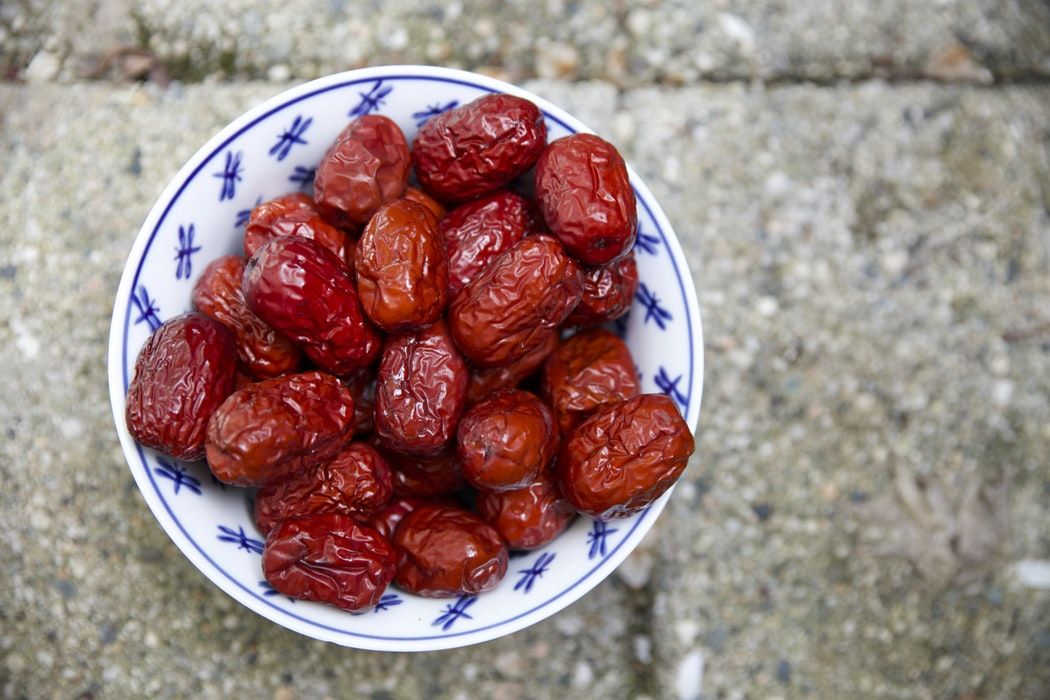
Readers in Selangor can also look at Pembekal Kurma Selangor. More about this site is on the About Us page and the contact page.
Keep the sun in the picture
The French study looked at diet and photoaging. It did not compare olive oil with sun protection, and a salad dressing is not sun protection. The NHS sun safety page says to spend time in the shade when the sun is strongest, to use at least factor 30 sunscreen, and: "Do not rely on sunscreen alone to protect yourself from the sun." If skin is the worry behind your interest in food, this site's earlier piece on acne and diet sets out what the studies there do and do not show.