
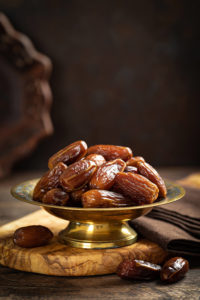
One practical way to pick healthy food for the family is to look at fibre. The NHS page "How to get more fibre into your diet" gives a daily target for adults, smaller targets for children, and a list of everyday swaps. This article walks through those numbers for a household, shows where dates sit on the NHS fibre label rule, and ends with a carrot and date side dish.
How much fibre each person needs
The NHS says government guidelines put dietary fibre at 30g a day for adults, as part of a healthy balanced diet, while adults eat an average of about 20g a day. Children need less, though still more than they get now:
| Age | Fibre a day (NHS) |
|---|---|
| 2 to 5 years | about 15g |
| 5 to 11 years | about 20g |
| 11 to 16 years | about 25g |
| Adults | 30g |
The page adds that children aged 11 to 18 get 16g a day on average. Its advice for them is plenty of fruit, vegetables and starchy foods, choosing wholegrain versions and potatoes with the skins on where possible.
Swaps for the shopping list
Start with breakfast. The NHS suggests a higher-fibre breakfast cereal such as plain wholewheat biscuits or plain shredded wholegrain, or porridge, since oats are also a good source of fibre. For bread, it suggests wholemeal or granary, or higher-fibre white bread. For the rest of the cupboard, it names wholewheat pasta, bulgur wheat and brown rice.
At dinner, the page suggests adding pulses like beans, lentils or chickpeas to stews, curries and salads, and including plenty of vegetables with meals, either as a side dish or added to sauces, stews or curries.
What a 30g day can look like
The NHS gives three example meals with their fibre content:
- Breakfast: 2 slices of wholemeal toast with peanut butter, then a medium-size orange, around 8.3g.
- Lunch: wholemeal spaghetti with lentil and tomato sauce, around 11g.
- Dinner: grilled chicken breast, skin-on baked potato, carrots and green beans, around 11.2g.
Added together, that comes to about 30.5g, right at the adult figure. The NHS is careful to say these examples are only illustrations, since the fibre in any food depends on how it is made or prepared and how much of it you eat.
Snacks and dried fruit
For snacks, the page lists fresh fruit, vegetable sticks, rye crackers, oatcakes, and unsalted nuts or seeds. Dried fruit gets a separate note: because it is sticky, it can increase the risk of tooth decay, so it is better eaten as part of a meal than as a between-meal snack. The NHS 5 A Day page names dates directly among dried fruits ("currants, dates, sultanas and figs") and counts a 30g portion as one of your 5 A Day.
Where dates sit on the fibre label rule
The NHS fibre page says high-fibre foods have 6g or more of fibre in every 100g. USDA FoodData Central gives Medjool dates 6.7g of fibre per 100g and Deglet Noor dates 8.0g per 100g, so both records clear that line.
| USDA record | Fibre per 100g | One pitted date | Fibre per date | Fibre per 30g portion |
|---|---|---|---|---|
| Medjool (FDC 168191) | 6.7g | 24g | about 1.6g | about 2.0g |
| Deglet Noor (FDC 171726) | 8.0g | 7.1g | about 0.6g | 2.4g |
A 30g portion therefore adds about 2g of fibre. Against a 30g adult target, that is one contribution among several. The NHS makes the same point in general terms: get fibre from a variety of sources, because "eating too much of one type of food may not provide you with a healthy balanced diet".
A carrot and date side dish
This dish puts two of the page's ideas on one plate: vegetables as a side dish, and dried fruit eaten with a meal rather than between meals.
Ingredients: peeled carrots, olive oil, salt, black pepper, garam masala, cinnamon powder, chilli powder, ginger juice and chopped dates.
For the ginger juice, grate fresh ginger root and press the pulp over a metal colander to collect the juice.
Preheat the oven to 210°C. Put the carrots in a bowl with the olive oil, salt, pepper, spices and ginger juice, and stir until every carrot is coated. Spread them on an oven tray, cook in the middle of the oven for 20 to 22 minutes until soft, then mix in the dates and serve.
Other articles on this site cover meals that carry calcium and healthy eating and the balanced diet.
More about this site is on the About Us page and the contact page.